
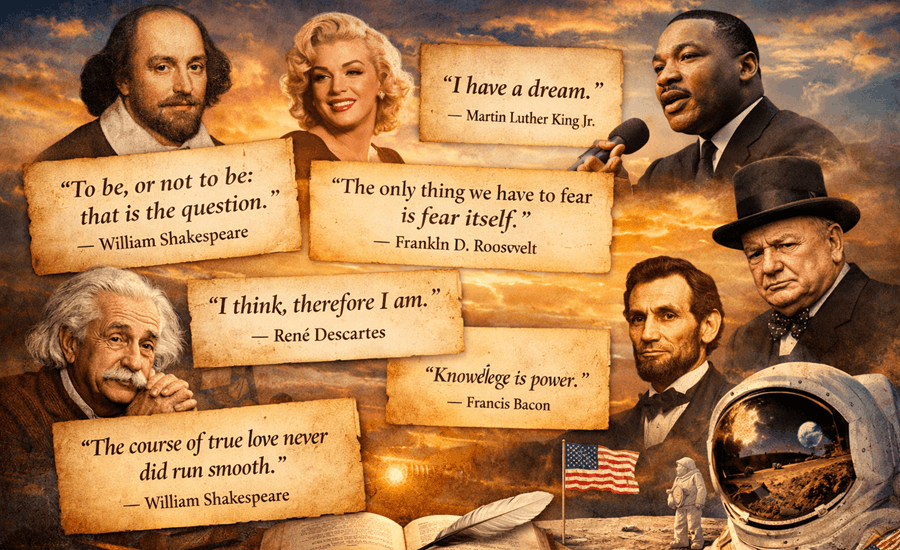
Some famous quotes stay popular because they are beautiful. Others last because they say something people still feel. This version keeps the focus on the collection itself, with stronger grouping, more quotes in each section, and short background notes that give each line a little context without getting in the way.
Most Famous Quotes of All Time
These are the lines that moved far beyond their original books, speeches, and historic moments. Even people who have never read the full text usually know these words.
-
- “To be, or not to be: that is the question.” — William Shakespeare
From Hamlet. It remains one of the most recognized lines in English literature because it turns doubt into a universal question.
- “To be, or not to be: that is the question.” — William Shakespeare
-
- “I think, therefore I am.” — René Descartes
From Descartes’s philosophical writing on certainty and existence. The line became a foundation of modern philosophy.
- “I think, therefore I am.” — René Descartes
-
- “The unexamined life is not worth living.” — Socrates
Known through Plato’s account of Socrates’ defense. It is still quoted whenever people speak about reflection, truth, and self-knowledge.
- “The unexamined life is not worth living.” — Socrates
-
- “The only thing we have to fear is fear itself.” — Franklin D. Roosevelt
From Roosevelt’s 1933 inaugural address. It became famous because it confronted national panic with one direct sentence.
- “The only thing we have to fear is fear itself.” — Franklin D. Roosevelt
-
- “Ask not what your country can do for you—ask what you can do for your country.” — John F. Kennedy
From Kennedy’s 1961 inaugural address. It remains one of the clearest calls to public service in American political speech.
- “Ask not what your country can do for you—ask what you can do for your country.” — John F. Kennedy
-
- “Government of the people, by the people, for the people, shall not perish from the earth.” — Abraham Lincoln
From the Gettysburg Address. The line still stands as one of the strongest definitions of democratic government.
- “Government of the people, by the people, for the people, shall not perish from the earth.” — Abraham Lincoln
-
- “I have a dream.” — Martin Luther King Jr.
From the 1963 March on Washington speech. Few modern phrases carry more moral force or historical memory.
- “I have a dream.” — Martin Luther King Jr.
-
- “That’s one small step for [a] man, one giant leap for mankind.” — Neil Armstrong
Spoken during the Apollo 11 moon landing. It became one of the most memorable lines ever attached to human exploration.
- “That’s one small step for [a] man, one giant leap for mankind.” — Neil Armstrong
Famous Quotes About Life and Perspective
Life quotes stay popular because they help people think more clearly. Some are poetic. Some are blunt. The best ones do both at once.
-
- “All the world’s a stage, / And all the men and women merely players.” — William Shakespeare
From As You Like It. Shakespeare turns ordinary life into a larger performance, which is part of why this line still feels fresh.
- “All the world’s a stage, / And all the men and women merely players.” — William Shakespeare
-
- “It was the best of times, it was the worst of times…” — Charles Dickens
From A Tale of Two Cities. This opening stays famous because it captures contradiction so perfectly.
- “It was the best of times, it was the worst of times…” — Charles Dickens
-
- “Two roads diverged in a wood, and I— / I took the one less traveled by, / And that has made all the difference.” — Robert Frost
From “The Road Not Taken.” It remains a favorite line for moments of choice and turning points.
- “Two roads diverged in a wood, and I— / I took the one less traveled by, / And that has made all the difference.” — Robert Frost
-
- “The woods are lovely, dark and deep, / But I have promises to keep, / And miles to go before I sleep.” — Robert Frost
From “Stopping by Woods on a Snowy Evening.” The closing lines are remembered for their calm beauty and quiet sense of duty.
- “The woods are lovely, dark and deep, / But I have promises to keep, / And miles to go before I sleep.” — Robert Frost
-
- “Hope is the thing with feathers— / That perches in the soul—” — Emily Dickinson
From Dickinson’s famous poem about hope. The image is simple, but it stays with readers for a long time.
- “Hope is the thing with feathers— / That perches in the soul—” — Emily Dickinson
-
- “There is nothing either good or bad, but thinking makes it so.” — William Shakespeare
From Hamlet. It still resonates because it points to how much perspective shapes experience.
- “There is nothing either good or bad, but thinking makes it so.” — William Shakespeare
-
- “This above all: to thine own self be true.” — William Shakespeare
Also from Hamlet. It remains one of the most widely repeated lines about honesty and personal integrity.
- “This above all: to thine own self be true.” — William Shakespeare
-
- “The fault, dear Brutus, is not in our stars, / But in ourselves.” — William Shakespeare
From Julius Caesar. This line has lasted because it rejects excuses and puts responsibility back on people.
- “The fault, dear Brutus, is not in our stars, / But in ourselves.” — William Shakespeare
-
- “I am no bird; and no net ensnares me: I am a free human being with an independent will.” — Charlotte Brontë
From Jane Eyre. Readers still love it because it speaks so clearly about dignity, freedom, and self-respect.
- “I am no bird; and no net ensnares me: I am a free human being with an independent will.” — Charlotte Brontë
-
- “Knowledge is power.” — Francis Bacon
A short line that became famous far beyond its original setting. Its staying power comes from how much it says in so few words.
- “Knowledge is power.” — Francis Bacon
Famous Love Quotes
Love quotes are some of the most searched and shared lines anywhere. The best ones do not just sound romantic. They capture devotion, longing, admiration, and the deeper side of connection.
-
- “Let me not to the marriage of true minds / Admit impediments.” — William Shakespeare
From Sonnet 116. It opens with one of the clearest and most enduring statements about lasting love.
- “Let me not to the marriage of true minds / Admit impediments.” — William Shakespeare
-
- “Love is not love / Which alters when it alteration finds.” — William Shakespeare
Also from Sonnet 116. This line is still quoted because it defines love as steady rather than fragile.
- “Love is not love / Which alters when it alteration finds.” — William Shakespeare
-
- “Shall I compare thee to a summer’s day? / Thou art more lovely and more temperate.” — William Shakespeare
From Sonnet 18. Few openings in love poetry are more famous than this one.
- “Shall I compare thee to a summer’s day? / Thou art more lovely and more temperate.” — William Shakespeare
-
- “If music be the food of love, play on.” — William Shakespeare
From Twelfth Night. The line is remembered for its dramatic, musical way of describing desire.
- “If music be the food of love, play on.” — William Shakespeare
-
- “But, soft! what light through yonder window breaks? / It is the east, and Juliet is the sun.” — William Shakespeare
From Romeo and Juliet. It remains one of the most iconic expressions of romantic admiration.
- “But, soft! what light through yonder window breaks? / It is the east, and Juliet is the sun.” — William Shakespeare
-
- “Parting is such sweet sorrow, / That I shall say good night till it be morrow.” — William Shakespeare
Also from Romeo and Juliet. It lasts because it captures how love can make goodbye feel tender and painful at the same time.
- “Parting is such sweet sorrow, / That I shall say good night till it be morrow.” — William Shakespeare
-
- “How do I love thee? Let me count the ways.” — Elizabeth Barrett Browning
From Sonnet 43. This opening line has become a classic choice for weddings, cards, and romantic writing.
- “How do I love thee? Let me count the ways.” — Elizabeth Barrett Browning
-
- “Whatever our souls are made of, his and mine are the same.” — Emily Brontë
From Wuthering Heights. The line still feels intense because it treats love as something deep and inseparable.
- “Whatever our souls are made of, his and mine are the same.” — Emily Brontë
-
- “You must allow me to tell you how ardently I admire and love you.” — Jane Austen
From Pride and Prejudice. It remains one of the best-known declarations in classic fiction.
- “You must allow me to tell you how ardently I admire and love you.” — Jane Austen
-
- “The course of true love never did run smooth.” — William Shakespeare
From A Midsummer Night’s Dream. The line stays popular because it still sounds true.
- “The course of true love never did run smooth.” — William Shakespeare
Famous Quotes About Courage, Strength, and Resolve
Some quotes are not soft at all. They challenge, push, and steady people. These are the lines readers return to when they need nerve, endurance, or a reminder to keep going.
-
- “Blood, toil, tears, and sweat.” — Winston Churchill
From Churchill’s first speech as prime minister in 1940. The line became famous because it promised struggle with total honesty.
- “Blood, toil, tears, and sweat.” — Winston Churchill
-
- “We shall fight on the beaches…” — Winston Churchill
From Churchill’s wartime speech after Dunkirk. It remains one of the strongest public statements of resistance ever delivered.
- “We shall fight on the beaches…” — Winston Churchill
-
- “We shall never surrender.” — Winston Churchill
From the same 1940 speech. Few short lines carry the same feeling of resolve.
- “We shall never surrender.” — Winston Churchill
-
- “Do not go gentle into that good night.” — Dylan Thomas
From Thomas’s famous villanelle. The line is still used when people speak about defiance, loss, and refusing to fade quietly.
- “Do not go gentle into that good night.” — Dylan Thomas
-
- “Rage, rage against the dying of the light.” — Dylan Thomas
Also from the same poem. Its repeated force is exactly what made it unforgettable.
- “Rage, rage against the dying of the light.” — Dylan Thomas
-
- “I am the master of my fate: / I am the captain of my soul.” — William Ernest Henley
From “Invictus.” It became one of the most quoted lines about self-command and inner strength.
- “I am the master of my fate: / I am the captain of my soul.” — William Ernest Henley
-
- “My head is bloody, but unbowed.” — William Ernest Henley
Also from “Invictus.” It remains powerful because it compresses pain and endurance into a single line.
- “My head is bloody, but unbowed.” — William Ernest Henley
-
- “If you can keep your head when all about you / Are losing theirs and blaming it on you…” — Rudyard Kipling
From “If—”. It is still quoted as a model of calm under pressure.
- “If you can keep your head when all about you / Are losing theirs and blaming it on you…” — Rudyard Kipling
-
- “If you can meet with Triumph and Disaster / And treat those two impostors just the same…” — Rudyard Kipling
Also from “If—”. The line lasts because it speaks to balance in both winning and losing.
- “If you can meet with Triumph and Disaster / And treat those two impostors just the same…” — Rudyard Kipling
-
- “Free at last! Free at last! Thank God Almighty, we are free at last!” — Martin Luther King Jr.
From the close of the “I Have a Dream” speech. It remains one of the most moving endings in American public speech.
- “Free at last! Free at last! Thank God Almighty, we are free at last!” — Martin Luther King Jr.
The strongest famous quotes keep traveling because they keep working. A line may begin in a play, a poem, or a speech, but the best ones do not stay there. They move into ordinary life and still sound alive every time someone reads them.